Waterproof Shade Sail vs. Non-waterproof Shade Sail: Which one should you choose?

Shade Sail has become a proven shading solution for courtyards, terraces, balconies, and commercial outdoor spaces. Compared to traditional awnings or fixed roofs, it offers advantages in visual lightness, spatial adaptability, and installation flexibility.
However, when making a purchase, many people encounter the same problem: which type of shade sail is more suitable, a waterproof one or a non-waterproof one?
On the surface, it seems like a simple matter of whether or not it needs to be rainproof; in reality, it relates to wind load, safety, long-term durability, and compatibility with the usage environment. Ignoring these considerations could lead to a poor choice that negatively impacts the user experience and introduces potential problems.
This article will analyze the differences between the two from the perspectives of materials, stress principles, wind and rain environments, and practical use, and will emphasize that the waterproof type is not suitable for permanent strong wind environments.
The fundamental difference between waterproof and non-waterproof shade sails
1. Fabric structure determines “working method.”
Waterproof
The surface has a rainproof coating
The fabric is almost non-breathable
Rainwater will be blocked
Non-waterproof
High-density weaving, retaining micropores
Its main functions are to provide shade and cooling.
Therefore, the two are subjected to forces in the wind in completely different ways.
2. The shading effects are similar, but the wind pressure differs significantly.
Waterproof Shade Sail: Wind is completely blocked.
Non-waterproof Shade Sail: Some wind can penetrate, providing pressure relief.
This is why whether or not it is waterproof directly affects the safety of use.
Why are waterproof products unsuitable for prolonged strong wind environments?
1. Bear the full wind load
Waterproof types are almost completely airtight, so wind pressure acts directly on the entire surface, and tensile force is concentrated at fixed points. Prolonged stress may lead to:
Metal fastener fatigue
Tension on walls or columns
sail edge deformation
These problems usually accumulate slowly rather than occur suddenly.
2. High risk due to combined wind and rain.
When wind and rain occur simultaneously, the waterproof Shade Sail faces triple pressure:
Continuous wind pressure
Rainwater increases weight
Water accumulation changes the direction of force
Even with a slope, strong winds can still cause localized water accumulation and a sudden increase in tension.
3. Permanent strong winds ≠ occasional winds
Characteristics of areas with persistently strong winds:
High average annual wind speed
Wind direction is changeable
Open and unobstructed
Wind is the norm
In this environment, shade sail requires proper pressure relief, and waterproof versions are unsuitable due to complete blockage.
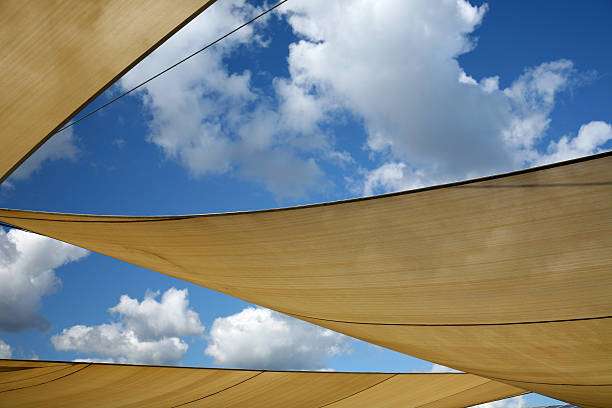
Why are non-waterproof types more suitable for strong wind environments?
The breathable structure with natural pressure-relieving
Micropores allow airflow to pass through, reducing overall wind pressure and dispersing tension at fixed points.
It does not accumulate water and is stable under stress
with minimal weight change in rainy weather, and its structure remains stable throughout.
It has higher durability
, no coating aging issues, good UV resistance, and predictable service life.
Therefore, many long-term projects will replace the waterproof shade sail with a non-waterproof one.
Selection suggestions for different environments
Non-waterproof type for areas with persistently strong winds (coastal areas, high-rise buildings, open areas)
For standard residential courtyards/balconies,
non-waterproofing
is recommended; for waterproofing, wind conditions need to be assessed.
Waterproof design for commercial terraces/temporary events (excluding areas with strong winds; professional installation required).
Common Misconceptions
Waterproof is definitely safer
The waterproof type can withstand all weather conditions for a long time.
Tighten it, and there won’t be any problems.
In reality, safety depends more on wind conditions than on rainfall.
FAQ
Can the waterproof shade sail be used as a long-term awning?
It is not recommended, as the sail itself is not a structural awning.
Q2: Is the experience of using the non-waterproof shade sail bad in the rain?
Rainwater will pass through naturally and will not drip or accumulate.
Q3: Can waterproofing in strong wind areas be solved by reinforcement?
Reinforcement can only delay the problem; it cannot change the way the wind is received.
Q4: What are the key indicators for selection in strong wind environments?
Air permeability and stability.
Q5: Can different types be used in combination?
It would be more reasonable to use them separately in different regions.
In conclusion
When choosing a shade sail, the key is not that the more features the better, but rather that it matches the environment.
Strong wind environment: The waterproof type is not suitable; the non-waterproof type is recommended.
Low wind speed and occasional rain: The waterproof type can be considered, but installation conditions need to be assessed.
Safety should take precedence over rain protection needs.
Choose a suitable shade sail based on actual wind conditions and usage cycle to reduce maintenance costs and ensure long-term comfort and safety.