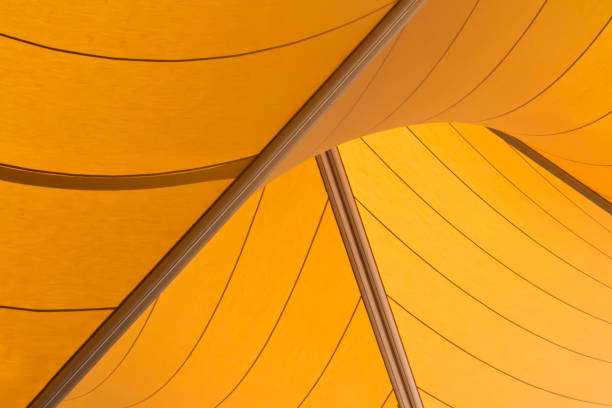
Do shade sails require pillars? A guide clarifying the differences between structure, scenarios, and real-world use.

Shade sailers have become an increasingly common shading solution in courtyards, terraces, balconies, and even commercial outdoor spaces. Compared to traditional umbrellas or fixed awnings, they are lighter, offer greater design flexibility, and are easier to integrate into modern space designs. However, when actually purchasing and installing them, one unavoidable question is frequently raised: Does a shade sail always require a support post?
Some people think that Shade Sail is simply “something you can install by pulling a few ropes,” while others find that not adding a support post causes a host of problems after installation. In fact, there is no one-size-fits-all answer to whether or not a support post is needed; it depends on the spatial structure, the conditions of the installation site, the shading requirements, and long-term usage expectations.
A shade sail needs a support column from the perspectives of structural principles, installation methods, adaptability to different scenarios, and maintenance, helping you to think it through before placing an order, rather than having to redo it after installation.
First, let’s figure out: How did Shade Sail “stand firm”?
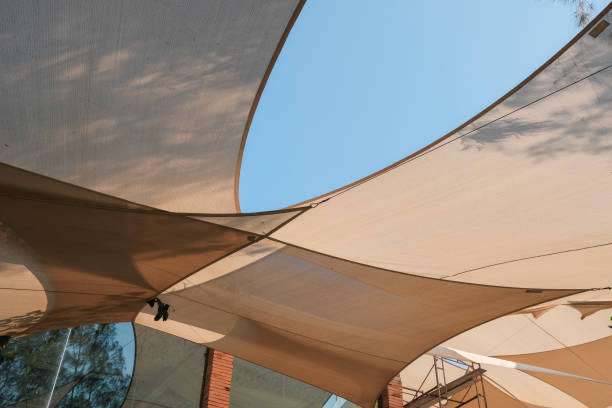
A shade sail is not essentially “supported” but rather pulled up.
It relies on the force at its four corners (or triangles) to stretch the fabric through cables, thus forming a stable shading surface. What truly determines the stability of the shade sail is not the fabric itself, but the following three factors:
Are the fixing points secure?
Is the direction of force reasonable?
Is long-term tensile strength sustainable?
This is precisely the key to whether “pillars” are necessary.
Shade Sail without pillars: In what situations is it suitable?
Under certain conditions, Shade Sail can indeed be fixed directly to the existing structure without the use of columns.
1. There are already secure fixing points.
If the following structure already exists in the space:
concrete walls
Load-bearing beams or eaves
steel structure columns
reinforced timber structure
These can all serve as anchor points for the shade sail. In this case, as long as the tension angle is designed properly, the shade sail can be used stably without additional supports.
2. Small area and low windward surface
Small-sized shaded sails (such as those used for balconies or window shades) have relatively low tensile strength requirements and can maintain good condition even without the use of supports.
3. Temporary or seasonal use
For example, in scenarios where the equipment is only used for a short period during the summer and requires frequent disassembly and assembly, not adding a support column would make the overall design more flexible.
However, it’s important to note that
Not using support posts does not mean there are no risks.
If the anchor points are not strong enough, the wall, expansion bolts, or connectors may loosen after prolonged stress.
Shade Sail requiring pillars: a common but underestimated situation
In many real-world applications, Shade Sail, when used with support pillars, is actually safer and more stable.
1. Open space, without a suitable fixed point.
In locations such as lawns, the center of courtyards, and beside swimming pools, there are often no walls or structures that can be directly used. In these cases, erecting columns is almost the only option.
2. Large shading area
As the size of the shade sail increases, wind loads and tensile forces increase significantly. If relying solely on a wall, this can easily lead to:
Uneven stress on the wall
Fastener fatigue
Fabric sagging or deformation
The columns can better distribute the tensile force, extending the lifespan of the shade sail and the building structure.
3. Precise control of height and tilt angle is required.
Ideally, the shade sail is not perfectly horizontal but rather slightly sloped to facilitate drainage and improve wind resistance. The columns allow for more flexible height adjustments, rather than being limited by the existing structure.
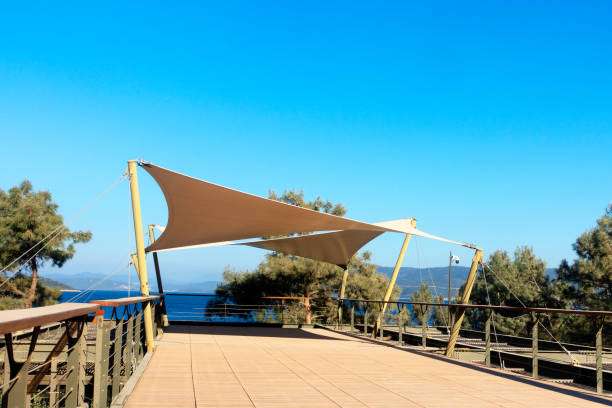
The function of the pillar is far more than just “adding another pole.”
Many people hesitate to add posts, mainly because they worry about aesthetics or increased costs. However, from a long-term usage perspective, the value of posts is often underestimated.
1. Improve overall stability
The shade sail generates continuous tension in the wind, and the column can transfer this force directly to the ground, rather than concentrating it at a point on the wall.
2. Reduce maintenance frequency
Properly installed posts can reduce the frequency of adjusting ropes, retightening, and checking fasteners.
3. Expand Shade Sail layout possibilities
With the pillars, Shade Sail is no longer limited by building boundaries and can cover more ideal locations, such as directly above a dining table or in the center of a lounge area.
Comparison of common scenarios: Is a pillar required?
|
Use cases |
Is it recommended to erect a pillar? |
reason |
|---|---|---|
|
balcony |
uncertain |
Many structures, small area |
|
Terrace against the wall |
Optional |
The wall needs to be strong enough. |
|
Central courtyard |
suggestion |
Lack of fixed points |
|
poolside |
suggestion |
Strong winds and open space |
|
Commercial Outdoor |
Strongly recommended |
Safety and durability are the top priorities. |
It can be seen that whether or not columns are needed is essentially a structural issue, not a product issue.
Four questions you must consider before installation
deciding whether to install pillars for a shade sail, it is recommended to carefully answer the following questions:
Is the fixed point a load-bearing structure?
Can it withstand long-term continuous tensile force?
Is the structure safe when strong winds or heavy rain comes?
Do you wish to adjust the position or change the size of the shade sail in the future?
If any of these issues makes you hesitate, using a pillar is often a safer choice.
FAQ:
Q1: Will it break more easily if I don’t install a support post?
If the fixing point is not strong enough, it will indeed be more likely to loosen, sag, or even break after long-term use.
Q2: Is it necessary to build a foundation for the pillars? For
Shade Sail pillars are intended for long-term fixation; it is recommended to build a foundation to ensure wind resistance.
Q3: Will columns affect the aesthetics?
With proper selection of color and material, columns can actually become part of the space rather than an obtrusive presence.
Q4: How many pillars are needed for a
Shade Sail? It depends on the distribution of the fixed points. Sometimes one is enough, and sometimes two or more are needed.
Q5: Can additional columns be added later?
Yes, but the tension structure will need to be readjusted, which will increase construction costs slightly.
Conclusion
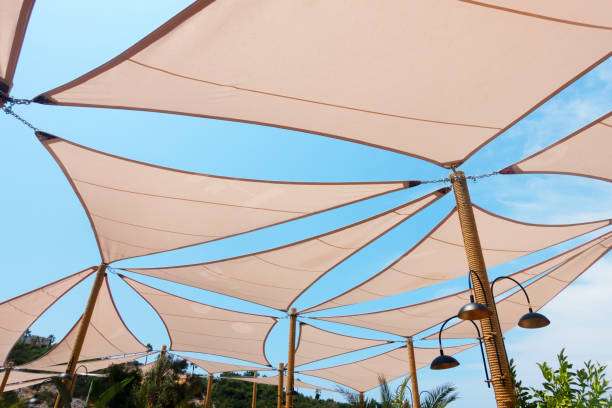
Shade Sail is a product that is highly dependent on installation conditions. Whether or not a support column is needed is not a matter of “saving money or not saving money,” but a comprehensive judgment of safety, stability, and user experience.
If you’re looking for long-term use, stable shading, and greater spatial freedom, then pillars are often not a burden but a guarantee.
If you are choosing the right shade sail for your patio, terrace, or outdoor space, consider starting with the installation structure and planning the posts and anchor points from the beginning to ensure a longer-lasting and more reliable shading effect.